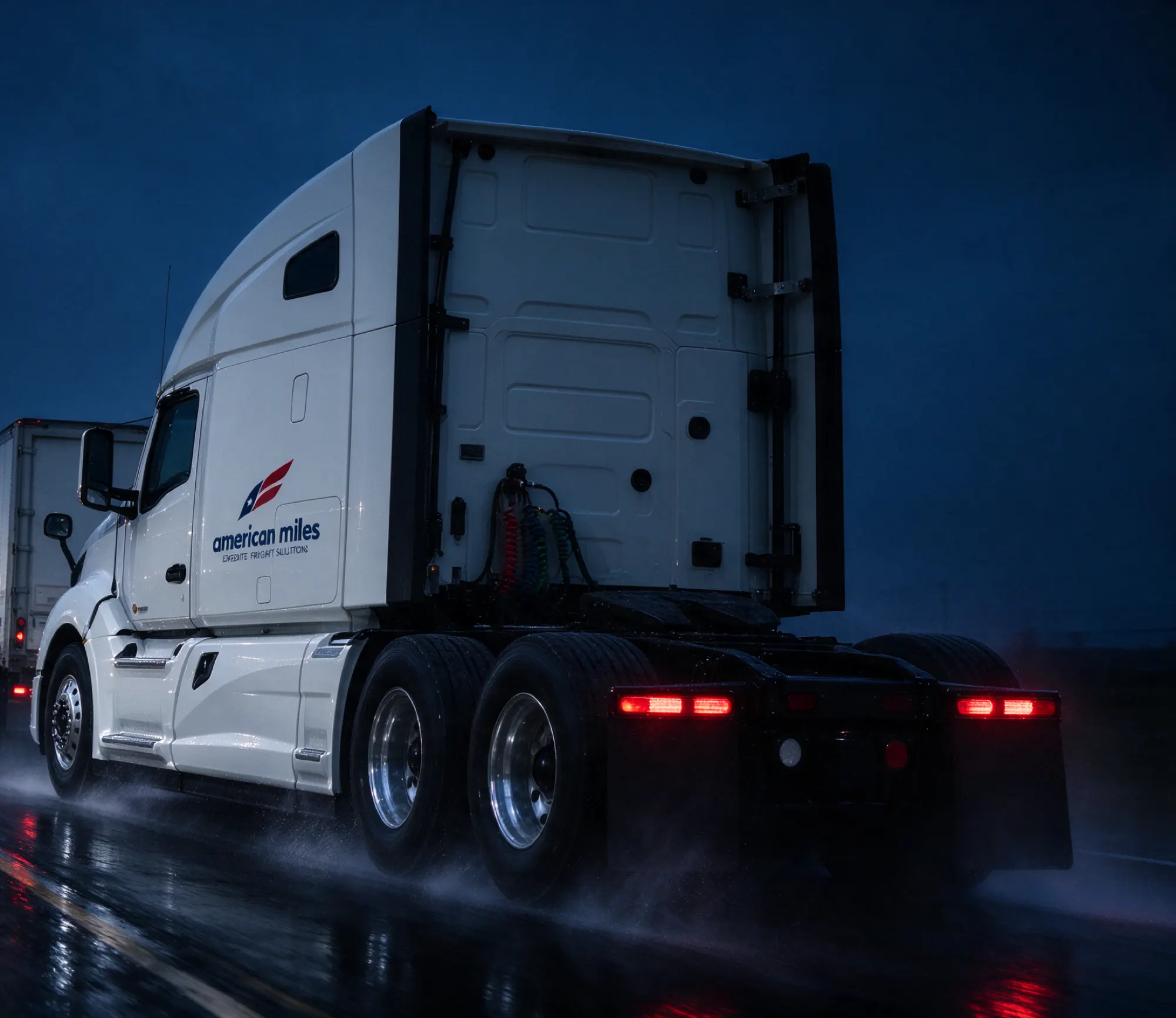
October 2026 brought new CDL rules for drivers and firm truckload rates despite softer freight volume. Diesel sat near $6.18 a gallon, cargo thefts got costlier, peak season ran lean and Class 8 truck orders jumped. Here's what each story means for drivers and shippers, with a source for every figure.
In this issue:
- Drivers: the 2026 rule changes you need to know
- Freight volumes dipped. Rates didn't. Here's why.
- Diesel is trucking's No. 1 concern in 2026
- Fewer cargo thefts, bigger losses: how to protect high-value freight
- Peak season 2026: what the parcel giants are planning
- EPA 2027 and the truck market: what fleets are buying now
1. Drivers: the 2026 rule changes you need to know
For Drivers · Compliance · ~4 min read
This year brought more changes to CDL rules than most drivers have seen in a decade. Here is a plain-language rundown of what's in effect, what's proposed and what's being tested. Always confirm current rules with FMCSA before you act on them.
| Change | Status | What it means for you |
|---|---|---|
| Non-domiciled CDL limits | In effect since March 16, 2026 | Eligibility narrowed to citizens, nationals, green-card holders and H-2A, H-2B or E-2 visa holders. Most existing licenses stay valid until expiration but need new proof to renew. |
| English proficiency (ELP) out-of-service rule | Proposed; comments closed Oct. 9 | Failing ELP would become a formal out-of-service violation in every MCSAP state. |
| Flexible sleeper berth pilot | Testing; formal pilots planned for 2027 | Split the 10-hour break into two periods, one at least 5 hours (today: 8/2 or 7/3 only). |
| Split-duty pilot | Testing; formal pilots planned for 2027 | Pause the 14-hour clock up to 3 hours a day in qualifying non-driving status. |
| ELD revocations | Ongoing | FMCSA revoked 15 ELDs in two months. Check your device against FMCSA's Registered Devices list. |
Sources: FreightWaves, Fleetworthy.
The medical card lesson
At CVSA's International Roadcheck in May, missing or invalid medical cards became the No. 1 driver violation. They were cited in 28% of driver violations, up from 18%. ELP appeared in the top violations for the first time. Keep your med card current and on hand.
Join a fleet that keeps you compliant
American Miles runs dedicated routes with a dispatch team that works around the clock. If you hold a valid Class A CDL and want consistent, professional freight, apply to drive with us, or see the open team-driving jobs.
2. Freight volumes dipped. Rates didn't. Here's why.
Market Update · For shippers and drivers · ~4 min read
Truckload rates stayed high in October 2026 even as freight volume fell, because carriers are rejecting more loads. If you expected rates to ease once the third-quarter rush ended, October has been a surprise. National tender volume fell about 6% from mid-September, yet carriers are rejecting more freight, not less. Rejections rose to 13.27% from 12.54% in September, according to Trinity Logistics' October update.
The numbers
| Measure | Latest | Context |
|---|---|---|
| Dry van spot linehaul | $2.26/mile | Up 35% year over year |
| Reefer spot linehaul | $2.75/mile | Up 33% year over year |
| Flatbed spot linehaul | $2.65/mile | Up 29% year over year |
| Dry van load-to-truck ratio | 10.5 | 6.3 a year ago |
| Van contract base rate | ~$2.73/mile | Near its one-year high |
Spot figures are DAT's for Oct. 4–10 (AJOT); the contract rate is from Trinity.
Why is truck capacity still tight?
Capacity is tight because trucks and drivers are leaving the market. FreightWaves SONAR reports that carrier rejections have risen 268% over three years while volume rose only 9%. For-hire tractor counts fell by about 51,000 in August alone (FreightWaves).
The driver pool is shrinking too. More than 202,000 CDL and permit holders sat in prohibited status in the Drug and Alcohol Clearinghouse at the start of 2026. Stricter non-domiciled CDL rules and English-proficiency enforcement are removing more drivers each month.
What does it mean for drivers?
Fewer trucks and fewer drivers on the road means steady freight for the drivers who are. Carriers are turning down loads because they lack trucks, not because freight dried up.
What does it mean for your freight?
In a market like this, the cheapest quote isn't the safest one. A load that gets rejected at tender costs more than one that moves on time. That's the case for dedicated capacity: trucks and drivers committed to your lanes, on your schedule, regardless of what the spot market does next week.
American Miles has built private fleet solutions for time-critical shippers since 2017. If tender rejections are putting your delivery windows at risk, talk to our team about dedicated capacity.
3. Diesel is trucking's No. 1 concern in 2026
Industry · For shippers and drivers · ~3 min read
Fuel prices jumped 17 spots to become the top issue in the American Transportation Research Institute's 22nd annual survey (Transport Topics). ATRI released it Oct. 18 at ATA's Management Conference & Exhibition in Charlotte, N.C. Nearly 3,100 carriers, drivers and other stakeholders responded.
For the first time, drivers themselves ranked fuel as their top concern. Diesel averaged $6.179 a gallon in mid-October, about $2.51 more than a year earlier, and topped $8 in California (Trinity Logistics). The EIA does not expect diesel to return to 2025 levels until at least 2028.
ATRI's 2026 top 10
- Fuel prices
- Lawsuit abuse reform
- CSA program
- Insurance cost and availability
- Driver shortage
- Economy
- Artificial intelligence
- Diesel emissions regulations
- Driver compensation
- Driver retention
Truck parking fell out of the overall top 10 but still ranked No. 2 among drivers.
Costs beyond the pump
ATRI also reported that operating costs excluding fuel reached $1.85 per mile, the highest in the 18 years it has tracked them. Insurance, equipment and driver pay are all pushing the total up.
How we respond
Fuel is a cost no carrier controls, but efficiency is. Dedicated routes reduce empty miles, and consistent lanes make fuel planning more predictable for both carrier and shipper. At American Miles, our 24/7 dispatch team plans every move around on-time delivery, so your freight keeps its schedule even when the market doesn't.
4. Fewer cargo thefts, bigger losses: how to protect high-value freight
Security · For shippers and drivers · ~4 min read
Cargo theft incidents are falling, but each theft is costing far more. Verisk CargoNet counted 677 thefts in the U.S. and Canada in Q2 2026, down 26% from a year earlier. Losses more than doubled to about $304.6 million, an average of roughly $564,000 per theft (TheTrucker.com).
At ATA's MCE26 in Charlotte, the industry put the annual cost as high as $6.6 billion, more than $18 million a day (Torque News). ATA's verdict: theft rings are "targeting freight with greater precision."
What are cargo thieves after?
- Metals: copper above all, plus aluminum, nickel and tungsten. Metal thefts rose from 54 to 80 in one quarter.
- Tech hardware: enterprise computing and networking gear and crypto mining hardware, often moving as ordinary dry van freight.
- Data: business email compromise and fictitious pickups, where criminals pose as legitimate carriers.
How can you protect freight from theft?
- Verify every carrier and driver before releasing a load, with a callback to a known number.
- Require multifactor authentication on company email.
- Treat last-minute changes to pickup or delivery instructions as a red flag.
- Share shipment details only with those who need them.
- Use secure, well-lit parking and never leave loaded trailers unattended.
- Report thefts quickly to law enforcement and CargoNet.
What does it mean for drivers?
Theft rings are targeting freight with greater precision. Park in secure, well-lit lots, never leave a loaded trailer unattended, and treat any last-minute change to pickup or delivery instructions as a red flag until dispatch confirms it.
Why dedicated helps
Many theft schemes exploit the handoffs of the spot market: unknown carriers, re-brokered loads and rushed instructions. A dedicated fleet removes most of those handoffs. You know the company, the dispatch team and the drivers moving your freight, every time.
5. Peak season 2026: what the parcel giants are planning
Peak Season · For shippers and drivers · ~3 min read
The holiday surge is weeks away, and UPS says it is entering peak "from a position of strength." The company reported Q3 2026 revenue of $22.9 billion, up 6.7%. On Oct. 27 it raised its fourth-quarter and full-year guidance (Logistics Management).
Peak by the numbers
- About 100 U.S. customers drive roughly 80% of UPS's peak surge.
- U.S. average daily volume is expected to rise about 25% from Q3 to Q4.
- Nearly 70% of packages will move through automated facilities.
- UPS plans fewer vehicle rentals and aircraft leases, adding variable capacity only where needed.
- Industry forecasts cited by CEO Carol Tomé call for about 9% average annual growth in holiday online sales.
The middle mile carries the load
Every package that reaches a doorstep in December first moves by truckload between hubs, sort centers and distribution centers. When networks run lean and add capacity "only where needed," reliable linehaul partners become essential. Missing one trailer can delay thousands of packages.
American Miles serves parcel and logistics leaders including UPS and FedEx, running time-critical freight with 24/7 dispatch. Peak is when that around-the-clock coverage matters most.
What does it mean for drivers?
U.S. average daily volume at UPS is expected to rise about 25% from Q3 to Q4, and every package moves between hubs by truckload first. For linehaul drivers, peak season means more freight to move.
Planning tip for shippers
Lock in capacity before the surge, not during it. With load-to-truck ratios already well above last year, last-minute spot coverage in December will be scarce and expensive.
6. EPA 2027 and the truck market: what fleets are buying now
Equipment · For shippers and fleet managers · ~3 min read
North American Class 8 orders reached 21,300 units in September, according to FTR preliminary data. That's up 18% from August and 3% from a year earlier (FreightWaves). Orders through September totaled 263,499, up 95% from the same period of 2025.
The pre-buy is over
FTR says the pre-buy ahead of EPA's 2027 NOx rules has ended, and surcharge-free model-year 2026 engine slots are essentially sold out. The final rule still hasn't been issued, and FTR warns it "could still materially alter" manufacturers' compliance plans.
The cost gap is real. FTR estimates nonconformance penalties would add about $6,000–$7,000 per truck, versus $8,000–$12,000 for a fully compliant engine.
Why does it matter to shippers?
New-truck costs flow into freight rates over time. Carriers facing higher equipment, insurance and fuel costs will price that in, and smaller fleets may delay replacements or exit. That's one more reason capacity stays tight.
FTR describes underlying demand as "fairly solid," supported by replacement needs, tight capacity and firmer rates. Expect orders to hover near year-ago levels until the rule is final.
Our fleet
American Miles runs modern Freightliner Cascadia, Volvo VNL and Kenworth T680 tractors. A dedicated fleet absorbs equipment planning for you, so you get the capacity without the capital outlay.
Sources
- October 2026 Freight Market Update, Trinity Logistics, Oct. 16, 2026
- DAT Spot Truckload Freight Market Report: Oct. 4–10, 2026, AJOT
- Is trucking capacity coming back?, FreightWaves, Oct. 7, 2026
- Fuel prices rank as trucking's most pressing concern, Transport Topics, Oct. 18, 2026
- Cargo theft losses more than double to $304M in Q2, TheTrucker.com, Aug. 7, 2026
- Cargo theft is costing trucking $18 million a day, Torque News, Oct. 22, 2026
- UPS posts 6.7% revenue growth in Q3, Logistics Management, Oct. 27, 2026
- FMCSA final rule and Dalilah's Law, FreightWaves, Mar. 19, 2026
- October 2026 Trucking Compliance Update, Fleetworthy, Oct. 6, 2026
- Class 8 truck orders rise 18% in September, FreightWaves, Oct. 5, 2026
- Federal Motor Carrier Safety Administration
- American Transportation Research Institute
- EIA Gasoline and Diesel Fuel Update